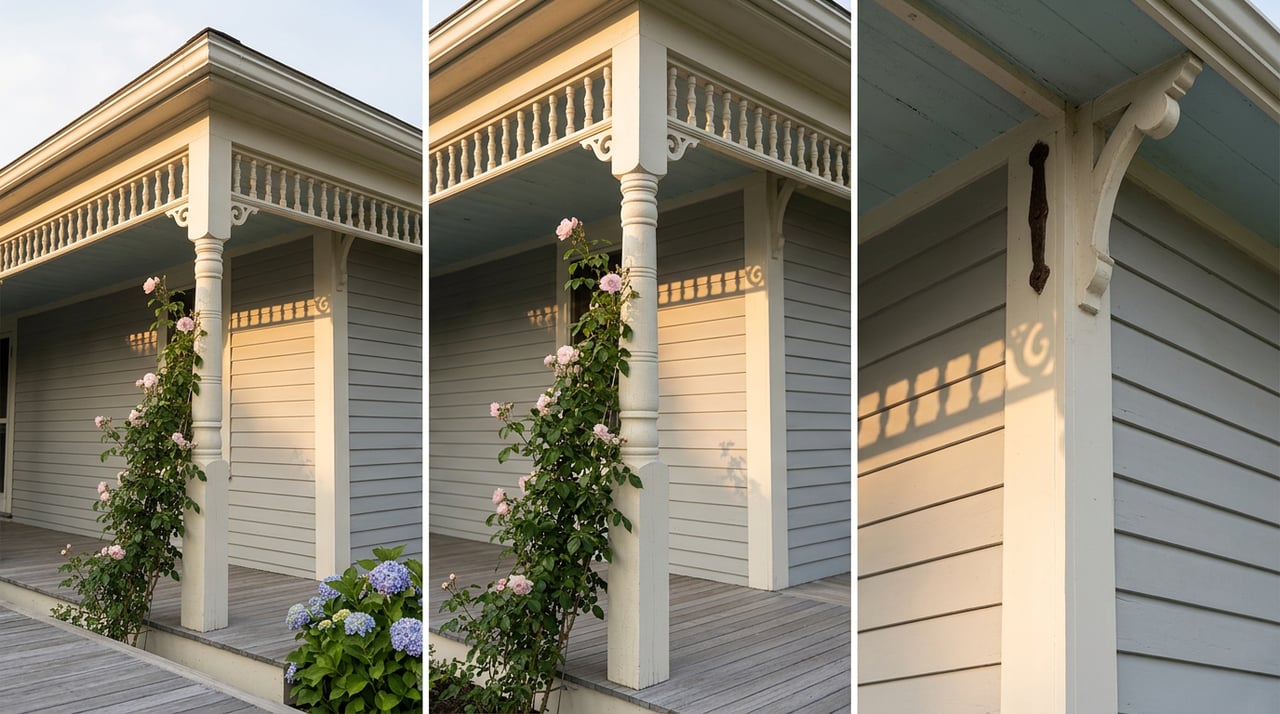
Cape May Historic Preservation Commission Renovation Rules Explained
September 3, 2026
September 3, 2026
Ask most buyers why a Cape May Victorian costs what it does, and you'll get the same answer: charm carries a per-square-foot tax. Pay more, get more character. It's a tidy story, and it's mostly wrong. As of August 30, 2026, the seventeen active listings inside Cape May's city limits carried an average price of $887.92 per square foot. A few miles up the peninsula, the countywide average across 596 active listings sat at $902.79 per square foot, slightly higher. The per-square-foot cost of a Cape May home and a typical Cape May County home are nearly identical.
What isn't identical is the price tag. Cape May's median list price that same month ran $2,195,000, more than three times the countywide median of $700,000. If the square footage isn't pricier, the house attached to it is. That gap is the thing worth understanding before you write an offer, because it points to a mechanism buyers rarely ask about until they're already under contract: Cape May's Historic Preservation Commission, under the city's historic-preservation ordinance, controls whether you can ever make that house smaller.
The City of Cape May's Historic Preservation Commission FAQs explain that Cape May's entire city is designated a National Historic Landmark District, not just a handful of Victorian showpieces on Hughes Street. That single fact shapes the market in a way a median price never captures. Nearly every closing in the city touches a property where exterior changes require sign-off from the Historic Preservation Commission, known locally as the HPC. The city has also long been described as holding the second-largest collection of Victorian structures in the country, after San Francisco. Scarcity like that doesn't behave like ordinary inventory. New construction can't expand it, and demolition can't easily thin it, because both require the HPC's approval before a permit is ever issued.
That's the backdrop for the size gap in the listing data. A grand Victorian built as a boarding house or a summer hotel annex in the 1880s came with a footprint that made sense for its original use: more bedrooms, more common space, more square footage than a modern buyer would choose to build today. Under Cape May's rules, tearing down or substantially reducing that footprint isn't a private decision. It's a public one.
Buyers often assume the HPC reaches further than it does. It doesn't touch interiors at all. Swap out a claw-foot tub, reconfigure a kitchen, gut a bathroom down to the studs, none of it requires a hearing. The commission also stays out of exterior color choices, a deliberate decision given how many architectural periods sit side by side across the city.
Where the HPC does step in is any exterior alteration, new construction, or demolition within the historic district. That work needs a Certificate of Appropriateness before a permit is issued, and the process branches in two directions depending on scope. The city's Historic Preservation Commission application says an Approval in Review stays valid for two years. Larger interventions don't get that shortcut. Demolitions, relocations, additions, new houses, and even solar panel installations all require a full hearing in front of the commission.
That last category surprises people. A rooftop solar array reads as a routine upgrade almost everywhere else on the Jersey Cape. In Cape May's historic district, it's treated with the same procedural weight as tearing down a wall.
Warren Coupland, a member of the commission for seventeen years and its current chair, has described the standard for new construction as asking builders not to copy historic architecture but, as reported by Preservation New Jersey, to offer "a contemporary interpretation of the style that is prevalent in the streetscape." That standard gives architects room to work, but it also means a buyer hoping to replace an oversized Victorian with something smaller and more efficient is negotiating with a public body whose stated goal is preserving the block's overall character, not accommodating one owner's preference for less square footage.
A Key Building is a unique architectural example of its period, the kind of structure the district exists to protect. The Mainstay Inn, The Abbey, and the Physick House are the commonly cited examples. A Contributing Building is different: its style isn't individually rare, but it reinforces the character of the block around it, the way the group of homes on the north side of New York Avenue between Madison and Trenton Avenues does.
Both categories require the same Certificate of Appropriateness for exterior work. Before you fall for a listing description, it's worth asking your agent which designation applies.
There's a second reason to read past the number on a portal's homepage. National listing trackers recorded only five closed sales in Cape May proper in March 2026, down from six the year before. With a sample that thin, a reported median can swing by double digits from one month to the next without any real shift in the market underneath it. That's not a Cape May quirk so much as a small-market math problem, but it's a sharper problem here than in a town with dozens of monthly closings, because Cape May's inventory is capped by the same commission rules that limit what can be built or torn down. Fewer possible transactions means each one carries more weight in the monthly average.
The takeaway isn't to distrust every number you see. It's to treat any single month's median as a snapshot of a handful of specific houses, not a verdict on the neighborhood. The more durable signal is the one sitting in the ordinance itself: a fixed, commission-reviewed stock of large historic homes that can't easily expand or shrink to meet demand.
If you're weighing a historic Cape May property against a newer build elsewhere on the Cape, the honest question isn't just whether you love the wraparound porch. It's whether you're prepared to own a house whose scale, layout, and systems are largely locked in by a public review process, and whether that trade fits how you actually plan to use the property. Some buyers want exactly that, a home that can't be altered into something generic. Others want the option to downsize a floor plan or add a primary suite without a hearing, and that buyer may be better served on a different block entirely.
Either way, this is the kind of detail worth working through with someone who reads the ordinance the same way she reads the comps. That's the guidance Teresa Campama brings to buyers considering the Jersey Cape's historic inventory, from sorting Key Buildings from Contributing ones to understanding what a Certificate of Appropriateness will and won't allow before you ever make an offer.
Does the Historic Preservation Commission control paint color? No. The commission has stated it does not rule on exterior color combinations, since the city spans multiple architectural eras with their own historically accurate palettes.
What's the real difference between an Approval in Review and a full hearing? An Approval in Review covers minor, same-for-same exterior work and can be granted by a subcommittee, staying valid for two years. A full commission hearing is required for demolitions, relocations, additions, new construction, and solar panel installations, regardless of how minor the homeowner considers the change.
Does owning a Contributing Building instead of a Key Building mean fewer restrictions? Not procedurally. Both require the same Certificate of Appropriateness for exterior changes. What differs is scrutiny: a Key Building's individual architectural significance tends to draw closer review of any proposed alteration, since the designation itself is built on the idea that the structure can't be replicated.
If you're evaluating a historic property in Cape May, or wondering what a similar home of yours might be worth in today's market, reach out for a free home valuation and a conversation about what the ordinance means for your specific address.
This article is general information, not legal, tax or financial advice. Consult a qualified professional about your situation.
Stay up to date on the latest real estate trends.



Get assistance in determining current property value, crafting a competitive offer, writing and negotiating a contract, and much more. Contact me today.