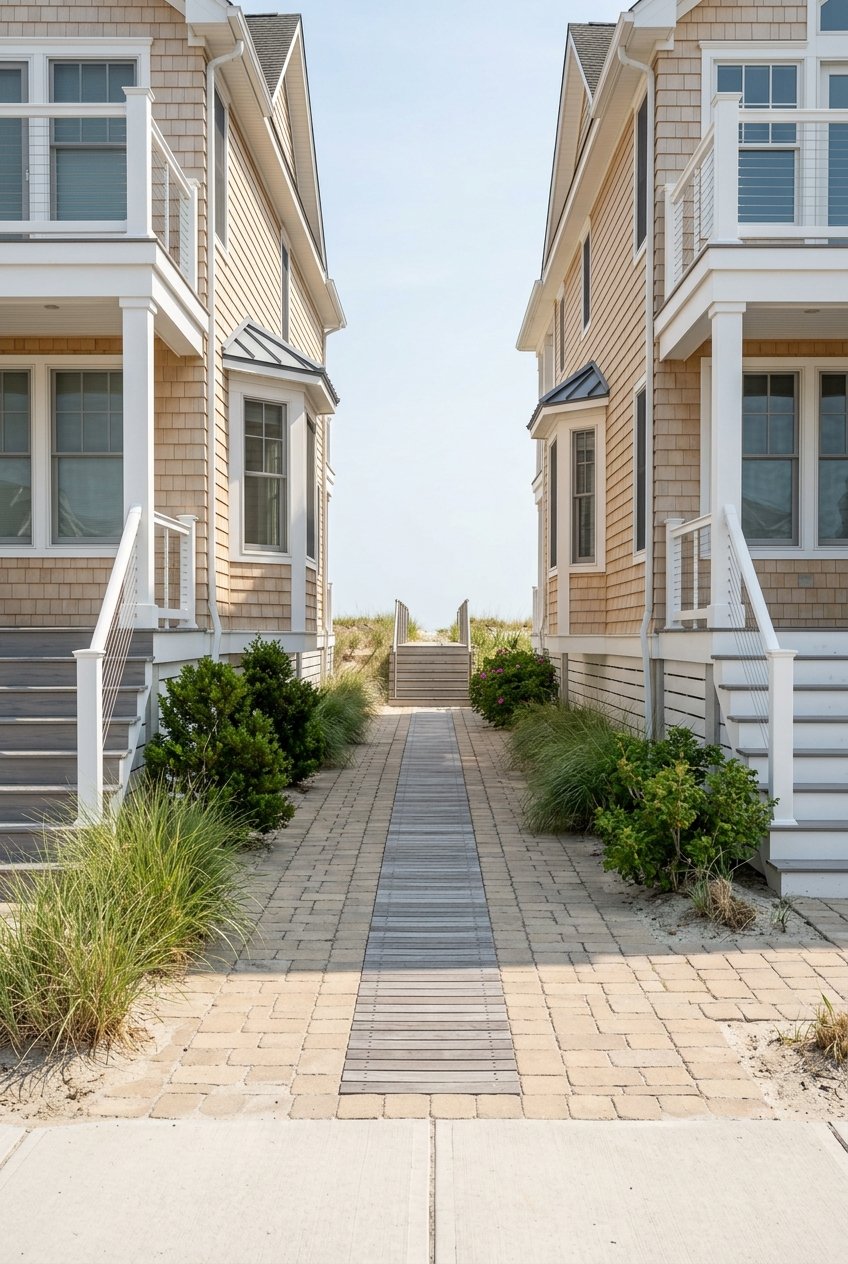
Ocean City NJ Areas Explained by Shorefront Setting
July 9, 2026
July 9, 2026
Wondering why one stretch of Ocean City’s shoreline feels lively and landmark-filled while another feels quieter and more residential? If you are thinking about buying, selling, or simply narrowing down where you want to focus, those block-by-block differences matter more than many people expect. Understanding how Ocean City’s shorefront changes from north to south can help you match the right setting to your lifestyle, priorities, and property goals. Let’s dive in.
Ocean City is a barrier-island community with the Atlantic Ocean on the east side, Great Egg Harbor Bay and the Intracoastal Waterway on the west, and Corson’s Inlet at the southern end. That geography shapes how different areas of the shoreline look, feel, and function.
The city’s public access plan notes that Ocean City has nearly 300 public access locations to the ocean, bayfront, and lagoons. It also states that the city provides extensive access through maintained paths, ramps, stairs, and the boardwalk. According to the Beach Patrol, Ocean City has about eight miles of oceanfront beaches.
The Beach Patrol organizes the shoreline into four zones centered at 1st, 12th, 34th, and 59th Streets. With roughly ten guarded beaches per zone and about 42 guarded beaches total, you can see that access and beach use are spread across the island, even though each area has its own personality.
If you want to be closest to Ocean City’s attraction core, the boardwalk-adjacent blocks stand out right away. The city describes its 2.5-mile boardwalk as the central focus of local attractions, with shops, restaurants, movie theatres, amusement rides, miniature golf, and a water park.
This part of the shoreline also carries some of Ocean City’s most recognizable historic resort character. The city has continued reinvestment in the downtown and boardwalk, including reboarding and handicap access, which reinforces this area as one of the island’s most public-facing and actively maintained stretches.
For buyers, that usually translates to a setting with the most immediate connection to the classic Ocean City experience. If your priority is being near the boardwalk’s energy and amenities, this zone often feels the most convenient and eventful.
The Historic District was created in 1992 and is roughly bounded by 3rd and 8th Streets and Central and Ocean Avenues. The city’s walking tour highlights landmarks such as the Ocean City Tabernacle, the 300 block of Central Avenue, the Parkside, the New Brighton Inn, Doctor’s Row, and the restored U.S. Lifesaving Station No. 30.
The architecture here includes Late Folk Victorian, Second Empire Mansard, American Four-square, Colonial Revival, Queen Anne Victorian, Folk Victorian, Spanish Revival, and Mission Revival styles. That variety gives this section a denser, older resort feel than many other parts of town.
Two especially notable examples are the Music Pier and the Flanders Hotel. The Music Pier, built in 1928 to 1929 after the 1927 fire, reflects Spanish Revival design, while the Flanders Hotel, built in 1922 to 1923, is a major Mission Revival landmark.
This area may appeal to you if you want:
For sellers, this part of town may also benefit from the strength of location-driven lifestyle appeal. When presentation and positioning matter, understanding how buyers perceive this setting can be especially valuable.
If you like staying close to the sand but want a setting that reads as more residential, the mid-island shoreline often becomes the focus. In this article, mid-island is best understood as the central shoreline band between the boardwalk core and the south-end preserve, rather than as an official neighborhood name.
Ocean City’s planning documents emphasize neighborhood-based zoning, discrete single-family zones, context-sensitive infill, and architectural design standards tied to compatibility. In practical terms, that supports a central stretch of shoreline that feels less landmark-dense and less entertainment-focused than the boardwalk core.
That does not mean sacrificing convenience. This part of Ocean City still benefits from the city’s broad beach-access system and public services, which keeps day-to-day beach use simple and appealing.
The city’s accessibility information identifies beach-access mats at Surf Road, Waverly Beach, Stenton Place, 14th Street, 34th Street Beach, and 58th Street Beach. Restrooms are located at 1st Street, 6th Street, Music Pier, 10th Street, 11th Street, 12th Street, 34th Street Playground, and 58th Street Beach.
Surf chairs are available at 1st, 12th, 34th, and 58th Streets. Those details matter if you are comparing convenience from one section of the island to another, especially for a second home or a property you expect guests to use regularly.
A useful way to think about the mid-island area is beach-first residential living. You stay close to the ocean while stepping back from the highest concentration of boardwalk traffic and landmark-focused activity.
This section may be a strong fit if you want:
For buyers considering a second home or boutique investment property, this balance can be appealing. You may get the convenience that supports shore living without centering every outing around the boardwalk zone.
At the southern end of Ocean City, the shoreline takes on a different identity. This is where the setting feels more nature-oriented and more closely tied to open sand, dunes, and protected coastal character.
A major influence here is Corson’s Inlet State Park. New Jersey DEP describes it as a quiet, undeveloped park with wild dunes, a cove lagoon, and beachfront access, and notes that it was established in 1969 to protect one of the last undeveloped tracts of oceanfront in the state.
The park is open from sunrise to sunset and charges no entrance fee. It is used for hiking, fishing, crabbing, boating, and sunbathing. Swimming is not allowed.
Ocean City’s public access plan also places Corson’s Inlet at the island’s southern end and uses similar language to describe it as a quiet, undeveloped state park. Combined with the Beach Patrol’s shoreline geography, the 50s and south-end shoreline are often the strongest match for those seeking the lowest-intensity oceanfront setting.
This area is not remote in a literal sense. It still benefits from city-managed access and patrol coverage, but its identity is shaped more by natural shoreline character than by entertainment-oriented activity.
If your goal is to be near open-space scenery and a more relaxed beach environment, the south end offers a distinctly different experience from the boardwalk-centered portion of town.
This area may appeal to you if you want:
For some buyers, especially those considering a vacation home for personal retreat, this difference can be the deciding factor.
When you step back and compare these shoreline sections, the differences become easier to see.
| Shorefront area | Overall feel | Best known for | Good fit if you want |
|---|---|---|---|
| Boardwalk-adjacent | Active and landmark-rich | Attractions, amenities, historic resort fabric | Immediate access to Ocean City’s entertainment core |
| Mid-island | Residential and beach-focused | Convenient beach access with less activity | A calmer shoreline feel while staying close to the beach |
| South end | Quiet and nature-oriented | Open-space character and Corson’s Inlet proximity | The lowest-intensity oceanfront setting |
Each section offers access to the shore, but the lifestyle experience changes meaningfully from one to the next. That is why hyperlocal guidance can make such a difference when you are evaluating where to buy or how to position a listing.
The best fit often comes down to how you want to spend your time at the shore. If you picture stepping right into the boardwalk scene, the northern core may feel like home. If you want beach convenience with a more residential rhythm, mid-island may make more sense.
If peace, dunes, and open-space character top your list, the south end deserves a closer look. For sellers, knowing which of these lifestyle priorities your property serves can also shape how it should be presented and marketed.
Ocean City is not one-note. Its shoreline offers several distinct experiences within the same barrier-island setting, and that is part of what makes the market so nuanced. If you want help narrowing the right block, property type, or pricing strategy in Ocean City or elsewhere along the Jersey Cape, connect with Teresa Campama for concierge-level guidance tailored to your goals.
Stay up to date on the latest real estate trends.

Get assistance in determining current property value, crafting a competitive offer, writing and negotiating a contract, and much more. Contact me today.